ICBME 2025 - Oral Presentation 2
Nov 20, 2025· ,,·
0 min read
,,·
0 min read
Seyed Sadjad Abedi-Shahri
Mitra Baradari
Iman Zoljanahi Oskui
Abstract
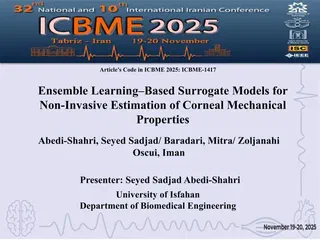
Accurate estimation of corneal mechanical properties is essential for advancing ocular biomechanics and improving the diagnosis of diseases like keratoconus. Conventional inverse finite element methods are often limited by their high computational cost and time requirement. In this study, surrogate models based on Random Forest, XGBoost, and LightGBM were developed to predict third-order Ogden material parameters from simulated corneal apex displacement data. Model performance was rigorously evaluated through mean squared error (MSE), coefficient of determination (R2), and a physics-informed stress-stretch error metric. The results demonstrated strong predictive accuracy in capturing the cornea’s mechanical behavior. Among the models, XGBoost achieved the closest match to the mechanical response, Random Forest provided robust overall accuracy, and LightGBM offered the fastest training. This machine learning-based approach effectively bridges the gap between clinical measurement data and intricate biomechanical properties, offering a fast, reliable, and non-invasive alternative to traditional inverse FEM methods.
Date
Nov 20, 2025
Event
Location
Tabriz University of Technology
Cornea
Inverse Problem
Machine Learning
Surrogate Modeling
Random Forest
XGBoost
LightGBM
Ogden Material Model

Authors
Assistant Professor of Biomedical Engineering
My research interests include Numerical Methods in Biomechanics, Scientific Computation, and Computational Geometry.